
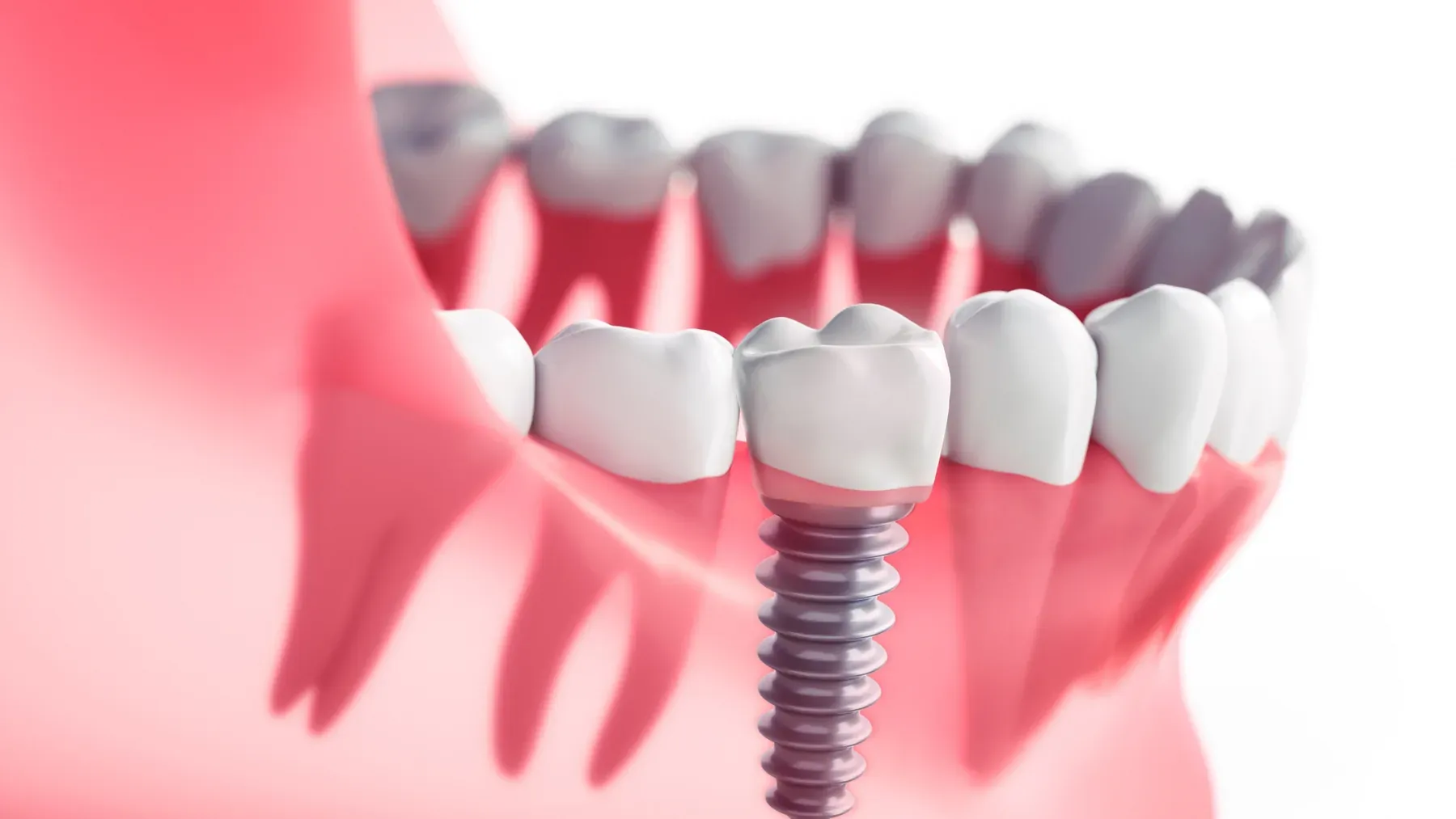
Losing a tooth takes away more than the part you can see. The root that once held the jawbone busy disappears with it. A dental implant replaces that root with a small titanium post placed into the bone, and the post then supports a crown, a bridge, or a denture above the gumline. It is the option to ask about when you would rather not lean a replacement tooth on the healthy teeth beside the gap.
How an implant rebuilds a tooth from the root up
Three separate pieces come together over time. First is the post, a small threaded cylinder of titanium set into the jawbone where the root used to sit. Over the months that follow, bone grows tightly against that surface in a process called osseointegration, and it is this bond, not a cement or a clasp, that gives the finished tooth its stability. Once the bone has done its part, a connector called an abutment is attached to the post, and a custom crown is fitted on top of that. Only the crown shows when you smile.
How Dr. Beaty coordinates your implant care
Implant treatment here is a team effort. Dr. Beaty examines the area, reviews your imaging and health history, and talks through whether an implant, a bridge, or a denture makes the most sense for you. When an implant is the right fit, she coordinates the surgical steps with a trusted network of dental specialists and shares your records and scans with them, so you are not starting over with someone new. She stays your point of contact along the way, helping you understand each stage and keeping the timing of every step connected.
What the treatment timeline usually looks like
Implant care is measured in months rather than appointments, and most of that stretch is healing time rather than chair time. Things start with an exam and imaging so Dr. Beaty can see how much healthy bone is available and where the nerves and sinuses sit. Placing the post is a short surgical procedure done under local anesthetic by a specialist from the network Dr. Beaty works with. You may wear a temporary tooth afterward if the space would otherwise show. A final impression or set of digital scans is taken once integration is confirmed, and the crown is seated at a later visit. Every mouth heals on its own schedule, so ask what yours is likely to be.
Why your jawbone drives the plan
Bone is the reason implant planning takes more thought than other replacements. After a tooth comes out, the ridge that held it slowly narrows because nothing is loading it anymore, and the longer a gap sits empty the more that ridge tends to change. An implant needs enough solid bone to hold it firmly, so measuring what remains is a real part of the evaluation. Where the ridge has thinned, grafting may be discussed to build the site up before anything is placed, which adds healing time to the schedule. Untreated gum disease, heavy smoking, and certain medical conditions also influence healing and are worth raising early rather than after treatment has begun.
Choosing between an implant, a bridge, and a denture
These options solve the same problem in genuinely different ways, and the right answer depends on your gap rather than on a ranking. A bridge fills a gap by capping the teeth on either side and spanning the space between them, which is faster but means preparing two otherwise sound teeth. A removable partial rests on the gums and clasps onto remaining teeth, asking nothing of the tooth structure but shifting a little as you chew. An implant stands on its own in the bone, leaves the neighbors alone, and keeps the ridge under load, though it asks the most of you in time and healing. Dr. Beaty will lay the trade-offs side by side rather than steering you toward one.
One tooth, several teeth, or a full arch
Implants are not only for single gaps. Two posts can carry a fixed bridge across a longer span without touching the natural teeth at either end. A larger number, placed at planned positions around the arch, can anchor a full set of replacement teeth so it locks onto the posts instead of resting on the gums: an implant-supported denture that stays where you put it while you eat. How many posts a case needs depends on available bone, on your bite forces, and on what you want the finished result to do. That plan is drawn up before surgery, not adjusted along the way.
Keeping an implant healthy for the long run
Day to day, an implant asks for the same habits as the teeth around it: brushing twice, cleaning between with floss or a small interdental brush, and keeping to your checkup interval. The crown itself cannot decay, but the gum and bone around the post can become inflamed when plaque is left to sit, and that inflammation is the most common reason an implant runs into trouble years later. Night grinding is worth mentioning too, since heavy clenching puts extra load on the restoration. If anything ever feels loose, sore, or different when you bite, book an appointment rather than waiting to see whether it settles.
Common questions about dental implants
Does getting a dental implant hurt?
The placement itself is done with local anesthetic, so the area is numb while the post goes in. Most people describe the days afterward as soreness rather than sharp pain, similar to having a tooth removed, and it usually settles within a week. Dr. Beaty will go over what to expect and how to manage discomfort before you start.
How long does the whole implant process take?
Plan on several months from start to finish. The post needs time to bond with the bone before it can carry a crown, and that healing phase is typically measured in months rather than weeks. If a graft or an extraction has to happen first, the timeline stretches further. Your own schedule depends on how your bone responds.
Does Dr. Beaty place implants herself?
Dr. Beaty works with a network of trusted specialists who handle the surgical side of implant care. She evaluates your situation, explains your options, and coordinates your treatment with the specialist, so your care stays connected from the first consultation onward.
Am I too old for a dental implant?
Age on its own is rarely the deciding factor. What matters more is the health of your jawbone and gums, how well you heal, and whether any medical conditions or medications affect bone healing. Adults in their seventies and eighties have implants placed routinely. A consultation and imaging will show whether your situation supports one.
What happens if I don't have enough bone?
A thin or shallow ridge does not automatically rule out an implant. Bone grafting can sometimes rebuild the site so a post has something solid to hold onto, though it adds healing time before placement. If grafting is not a good fit for you, a bridge or a removable option may be the more practical route. Imaging comes first either way.
